

What If AI Could Understand Your Food And Your Body At The Same Time? The Story Behind Building Hola Meal, an AI-Powered Nutrition Companion

Pleased know your body. This is a documentation of how I built Hola Meal, an AI nutrition assistant that understands both food and the people who eat it. First, a disclaimer: I built this out of curiosity, and it requires further development and research. I’m not a nutrition expert, but I care about this topic.

Phase 1 - What If AI Could Understand Your Food And Your Body At The Same Time?
“Do you realize that every time we eat, we’re actually making a health decision? It’s just that most of us never realize it.”
There’s one question that’s been on my mind for the past few months.
“Why does living a healthy life feel harder and harder, even though information about nutrition is now available everywhere?”
Today, we can find out the calorie count of a burger in just a matter of seconds. We can look up the sugar content of our favorite drinks online. In fact, almost every packaged food product now comes with a nutrition label.
In reality, however, noncommunicable diseases (NCDs)—such as heart disease, type 2 diabetes, stroke, obesity, hypertension, and certain types of cancer—remain the leading causes of death worldwide. According to the World Health Organization (WHO), an unhealthy diet is one of the primary behavioral risk factors contributing to the rise in these diseases.¹
Ironically, the problem is no longer that people lack information. Quite the opposite. We live in an era of abundant nutritional information.
The challenge now is how to use that information to make decisions about selecting foods that are suitable for our physical condition.
Imagine a simple situation. You’re having lunch at a restaurant. In front of you is a plate of rice, fried chicken, chili sauce, and a glass of cold drink. You might be able to answer the following questions.
“Is this food tasty?” The likely answer is “yes” for those who like it.
“Is this food filling?” Probably.
But what if the question changes to:
How much sodium does it contain?
Is the amount of carbohydrates still within the daily target?
Is the sugar content in that drink safe for people with diabetes?
Is this meal too high in purines for someone with a history of gout?
Does that food contain certain allergens, such as nuts or seafood?
I suspect most of us would start speculating. Yet for millions of people around the world, these questions are more than just a matter of curiosity. They will have a direct impact on their future quality of life.
Because, as far as I know, there’s a law of cause and effect—or “you reap what you sow.” What you plant is what you’ll get in the future. That’s the analogy. Please correct me if I’m wrong.
The more I read scientific journals on nutrition, the more I realize one interesting thing. For years, many health apps have been built on the same assumptions.
Everyone is assumed to need the same information. Everyone is assumed to have the same goals. Everyone is assumed to be able to follow the same diet. But the reality is actually the opposite.
There’s a fictional martial arts comic about the Tang family, who are experts in using poison. There’s a message hidden within it. In one scene, it says, “What you consume isn’t necessarily good for others.” If we examine this further, it could refer to certain ingredients that people with specific conditions—such as food allergies—should avoid, or foods that should be avoided due to pre-existing medical conditions. But let’s get back to a more serious topic.
Someone who is bulking has different protein and energy needs than a marathon runner.
People with chronic kidney disease have different nutritional considerations than someone who is on a weight-loss program.
The same applies to people with diabetes, hypertension, GERD, high cholesterol, or those with specific food allergies.
They may order the same meal. But the information they need is not the same. This concept has been increasingly discussed in recent years in the field of Precision Nutrition—an approach that tailors nutritional recommendations based on each individual’s biological characteristics, health status, lifestyle, and environment, rather than using a “one-size-fits-all” approach.²
That sentence kept echoing in my head.
“If food is personal, why are most nutrition apps still so generic?”
That simple question became the starting point for Hola Meal.
But before I started writing a single line of code or designing the first user interface, I felt I needed to understand one thing first:
“Is this problem really real?”
Or was it just my assumption? The answer turned out to be far more interesting than I had imagined.

Phase 2 - Nutrition Isn’t Just About Diet. It’s About Quality of Life.
At first, I thought calorie-counting apps were only used by people on a diet. I also used to think that nutritional information was only important for athletes or bodybuilders looking to build muscle mass. But the more research I read, the more I realized that this view was too narrow.
Nutrition turns out to be about more than just weight. Nutrition is the foundation of nearly every biological process that takes place in the human body. What we eat every day affects how our bodies produce energy, build tissue, regulate hormones, maintain the immune system, and even influences our risk of developing various chronic diseases in the future.³
In other words, food isn’t just a source of satiety. Food is a form of “biological information” that we send to our bodies several times a day.
Diet Is One of the World’s Largest Risk Factors for Disease
When I began reading the report from the Global Burden of Disease Study, I discovered something quite surprising.
For a long time, many people have considered smoking to be the primary cause of various diseases. In fact, dietary quality contributes significantly to global mortality and disability.
A study published in The Lancet estimates that in 2017, approximately 11 million deaths worldwide were linked to suboptimal dietary patterns. Factors such as high sodium intake and low consumption of whole grains, fruits, nuts, and other components of a healthy diet are the main contributors to this disease burden.⁴
That number is much higher than I imagined. Interestingly, this study doesn’t suggest that a single meal will make someone sick. Rather, health outcomes stem from thousands of small decisions we repeat every day over the course of many years.
This means that health isn’t shaped by a single healthy meal. Nor is it ruined by a single cheat meal. This is where I began to realize that health is shaped by patterns.
One Dish, Many Meanings
Imagine a plate of rice with roasted chicken. For a marathon runner, this meal might be a good source of carbohydrates and protein for recovery after a workout.
For someone on a bulking program, this meal could be part of a strategy to increase muscle mass.
But what if the person eating it has high blood pressure?
Or someone with chronic kidney disease?
Or someone who is allergic to one of the ingredients?
Suddenly, the same meal takes on a very different meaning.
This is where I began to realize that the right question is no longer:
“Is this meal healthy?” but rather, “Healthy for whom?”
This simple question turns out to be in line with the direction of modern nutritional science.
In recent years, researchers have increasingly been using the term precision nutrition, which refers to an approach that seeks to understand how genetic factors, metabolism, health conditions, physical activity, and even the environment influence an individual’s response to the same food.⁵
In other words, future nutritional recommendations will no longer be universal. Instead, they will be personalized.
Why Do So Many People Fail to Maintain a Healthy Diet?
I also discovered a fact that I find very interesting. Most people actually already know which foods are healthier.
We know that too much sugar isn’t a good choice. We know that excessive salt intake can increase the risk of hypertension. We know that ultra-processed foods shouldn’t be consumed in excess.
The problem isn’t a lack of knowledge. The problem is turning that knowledge into daily habits.
The WHO itself explains that a person’s living environment, food availability, prices, culture, and even the ease of accessing food greatly influence a person’s dietary choices. In other words, dietary decisions aren’t just a matter of willpower; they’re also influenced by the surrounding context.⁶
I think this is a very important perspective. We’ve often blamed individuals, when in fact the systems we use often aren’t helpful enough.
Technology Should Reduce Friction, Not Add to It
I then tried out various existing nutrition apps. Most of them have a nearly identical workflow.
Open the app. Search for the food’s name. Select the most similar item. Enter the serving size. Adjust the grams. Confirm. Repeat the process for dinner. Then do the same thing the next day.
At first glance, it seems simple. But imagine going through that process three times a day.
Every day. For months on end.
It’s no surprise that various studies on digital dietary assessment have found that manual food tracking often has low adherence rates. Many users stop tracking not because they don’t care about their health, but because the process requires too much effort to maintain over the long term.⁷
That discovery made me pause for a moment.
Perhaps the biggest problem isn’t people’s intention to live a healthy life.
Perhaps the problem is that the user experience is still too complicated.
As a product designer, I began to see this issue not just as a health problem, but also as a design problem.
There’s a Question That Changed the Way I View AI
I then imagined a very simple scenario.
What if people no longer had to type in the names of foods?
What if they didn’t have to search through a food database one by one?
What if a process that previously required dozens of taps on the screen could be replaced by a single
simple action:
Lift the camera. Take a photo. Then let AI do the rest.
That’s when I began to believe that advancements in computer vision and multimodal AI might not only change the way we use technology, but also the way we understand food.
And that’s where the idea for Hola Meal began to take shape. But before building the app, I wanted to answer one important question first.
“Is AI really mature enough to understand human food?”
That’s the question I set out to answer in the next phase of my research.

Phase 3 — When Computer Vision Meets Nutrition Science: Why Now Is the Right Time for AI
A few years ago, if someone had said that an app could recognize food just from a photo, I probably would have thought it sounded like something out of the future.
Not because the idea was impossible.
But because the technology simply wasn’t quite ready yet. Food is one of the hardest objects for a computer to recognize.
Unlike cars, cats, or chairs—which have relatively consistent shapes—no two servings of food ever look exactly the same.
A plate of fried rice made by one person can have a color, texture, portion size, and even ingredient composition that’s very different from fried rice made by someone else.
Not to mention cultural variations. A single type of food can have dozens of different versions in every country.
From a computer vision perspective, food is a highly complex object.⁸
AI Doesn't Really “See” Like Humans Do
Another thing I learned is that AI doesn’t actually understand food the way humans do.
When we look at a bowl of ramen, we immediately recognize the noodles, egg, slices of meat, green onions, and broth.
In contrast, AI models work differently. They learn from millions of image examples.
These models try to identify recurring visual patterns and then associate them with possible objects in the image. The more varied the training data, the better the model’s ability to recognize new foods.
It is this progress that has led to rapid advancements in the field of food image recognition over the past few years. Various deep learning-based models have demonstrated increasingly better performance in identifying food types and estimating their nutritional content, although challenges such as portion sizes, hidden ingredients, and mixed dishes remain active areas of research.⁹
In other words, AI isn’t perfect yet. But for the first time, AI is good enough to help humans make everyday decisions. And in my opinion, that’s far more important than striving for perfection.
From Recognizing Objects to Understanding Context
The greatest advancement isn’t just AI’s ability to recognize food. What’s far more interesting is the ability of modern AI models to understand relationships between pieces of information. Take a photo of food, for example.
A few years ago, AI might have only been able to say:
“This is a pizza.”
Today, multimodal models like Gemini can understand images while also connecting them to natural language, user context, and given instructions.
In other words, AI doesn’t just answer:
“What’s in this photo?”
But it’s also starting to help answer:
“Is this food in line with my health goals?”
This development is made possible by advancements in Vision-Language Models (VLMs)—models capable of processing visual and textual information simultaneously. In the context of digital health, the multimodal approach is seen as having great potential to support more context-aware decision-making compared to systems based solely on images or text.¹⁰
As I read through these various publications, I began to realize that the AI paradigm has shifted. We’re no longer just talking about computer vision. We’re starting to talk about AI that understands context.
However, There’s One Thing That I Think Is Still Missing
The more I try out the various AI food scanner apps that are available, the more I realize that most of them stop at the same point.
The user takes a photo. The AI recognizes the food. Then the app displays: Calories, Protein, Fat and Done.
But for me, those numbers are just the beginning. I keep asking myself:
If AI is already capable of understanding food...
“Why hasn’t AI tried to understand the people who are eating it?”
I Think Food Never Stands Alone
Imagine two people taking photos of a bowl of chicken noodle soup. The resulting photos might be nearly identical. An AI model would likely provide calorie estimates that are also nearly the same.
But should the recommendations be the same as well?
In my opinion, not necessarily. The first person is a 21-year-old college student who exercises five times a week.
The second person is a 58-year-old man managing type 2 diabetes and hypertension.
The calorie count might be the same.
But their biological contexts are completely different.
This is where I start to see a gap—not a technological gap, but a gap in the user experience.
AI is getting smarter at understanding images. But the user experience is still often treated as if everyone has the same body, goals, and health conditions.
In fact, research in the field of precision nutrition shows that a person’s response to food is influenced by various individual factors, including health conditions, physical activity, metabolism, and other biological characteristics.¹¹
For me, this is no longer a matter of AI accuracy. It’s a matter of system design.
As a Product Designer, I See Things Differently
At this point, I stopped thinking about technology. I started thinking about the user experience. Over the years I’ve worked as a Product Designer, I’ve learned one simple principle.
“Good technology isn’t the most advanced technology. Good technology is technology that understands its users’ context.”
If someone has a peanut allergy, then the most important information isn’t the number of calories.
If someone lives with hypertension, sodium levels are often far more important than total fat.
If someone is building muscle mass, their main focus might actually be protein intake.
I began to realize that AI doesn’t just need to recognize food.
AI also needs to recognize who is making that decision. And that’s when, for the first time, the concept of Hola Meal began to take a clear shape in my mind.
Not as a food recognition app. Not as a calorie tracker either. But as an AI-powered Personal Nutrition Assistant.
There Was a Phase I Went Through: A Simple Question That Changed the Direction of the Product
Instead of asking:
“How can we get AI to recognize food?”
I asked:
“What if AI could understand food while also understanding the body of the person eating it?”
That simple question ultimately changed the entire direction of product development. And the first design decision I made actually sounded a little strange.
I decided that users shouldn’t be able to take photos of food right away. Because before understanding the contents of the plate...
the AI must first understand who is sitting in front of that plate.
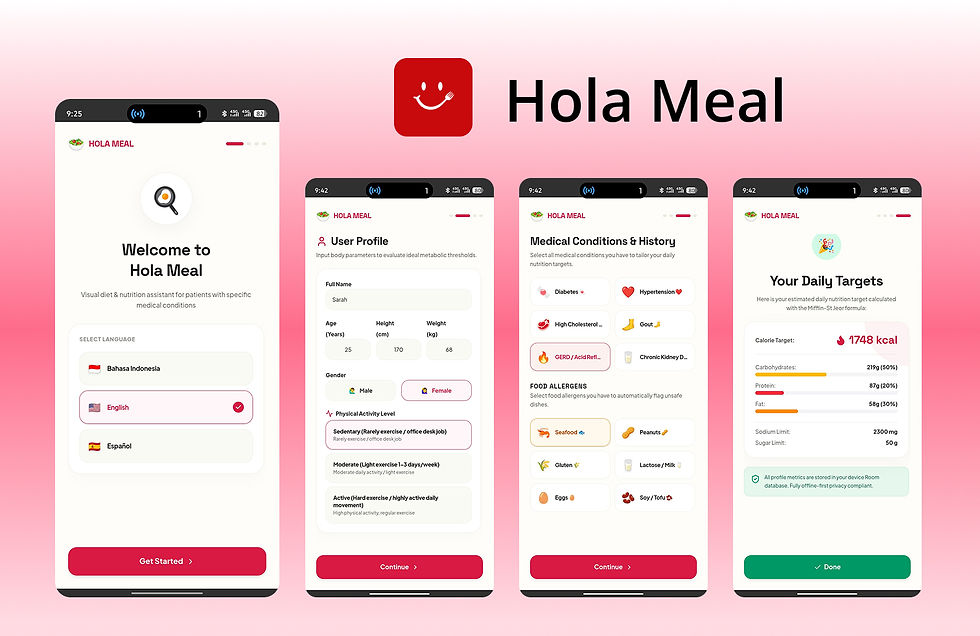
Phase 4 — Why Doesn't Hola Meal Ask Users to Take Photos of Their Food Right Away?
If you try most of the calorie-counting apps available today, the process is almost always the same.
Open the app. Search for a food item. Or take a photo of your meal right away. Then the app starts counting calories.
I did consider taking the same approach. From a user experience perspective, those steps do feel quick.
But the more I thought about the problem I wanted to solve, the more I felt something was missing. I kept coming back to one simple question.
“How can AI provide relevant recommendations if it doesn’t even know who the user is?”
To me, asking someone to take a photo of their food right away is like a doctor prescribing medication before knowing the patient’s medical history. The prescription might not be entirely wrong. But it might not be right either.
The Human Body Doesn't Come With “Factory Settings”
One of the most fascinating things about reading research on precision nutrition is the fact that there is no single diet that is truly ideal for everyone.
For decades, nutritional recommendations have largely been presented in the form of general guidelines.
Eat more vegetables. Cut back on sugar. Limit salt. Get more physical activity. All of these suggestions are certainly true.
However, science is beginning to show that the body’s response to food can vary from person to person.
Two people can eat the exact same food. In the exact same amount. At the exact same time.
Yet they may experience different blood glucose responses, different levels of fullness, and even different metabolic changes.¹²
Findings like these have driven the development of the field of precision nutrition—an approach that seeks to understand each individual’s unique characteristics before providing nutritional recommendations.
As I read through these various studies, I began to think. Perhaps nutrition apps should do the same.
I Think a Product Will Be Good If It Meets This Condition: Before Understanding Food, AI Must Understand People
That’s why Hola Meal didn’t start with a camera. It started with a profile. Before the AI sees a plate of food, I want it to first understand some basic things about the person who will be eating it.
It’s not about collecting as much data as possible. It’s about gathering only the information that’s truly relevant to providing context. Because context is always more valuable than mere numbers.
Why Are Height and Weight Important?
The first questions asked by Hola Meal may seem very simple.
“How tall are you? How much do you weigh?”
However, these two figures form the basis for various calculations of daily energy requirements that have long been used in clinical nutrition practice.
Body weight, height, age, gender, and activity level are the main components in estimating a person’s energy needs. Various international nutrition guidelines use these variables as the basis for calculating estimated daily calorie needs before formulating dietary recommendations.¹³
I don't want users to have to calculate all that manually. If the app can do it automatically, why make it more complicated?
Physical Activity Is Changing the Way We Think About Food
The next thing I entered was my activity level.
“Sedentary. Moderate. Active.”
At first, I thought this feature would only be useful for estimating calorie needs.
But the more I thought about it, the more I realized that physical activity actually changes the way we perceive food.
The same plate of rice might be an energy surplus for someone who works in front of a computer all day.
But for someone who runs ten kilometers every morning, that same meal might actually be part of the recovery process.
The WHO itself recommends that adults engage in 150–300 minutes of moderate-intensity physical activity per week, or 75–150 minutes of vigorous-intensity physical activity per week, because physical activity plays a crucial role in maintaining metabolic health and reducing the risk of various chronic diseases.¹⁴
In other words, food can never be separated from activity. The two always complement each other.
Have You Ever Heard About How Chronic Illness Changes Nutritional Priorities on a YouTube Podcast?
The next part was the design decision I pondered the most.
I decided to allow users to select their health conditions.
This wasn't to make a diagnosis. This was to help the AI understand that everyone has different nutritional priorities.
Someone living with diabetes might be more concerned about carbohydrate and sugar intake.
A person with hypertension might be more sensitive to sodium intake.
Someone with high cholesterol might be more cautious about certain types of fats.
People with GERD might need to be mindful of foods that potentially trigger symptoms.
People with chronic kidney disease often need to consider various nutritional aspects more specifically, as recommended by their healthcare provider.
All of these conditions have different information needs.
The WHO and various international health organizations consistently emphasize that managing non-communicable diseases requires lifestyle changes, including dietary adjustments tailored to each individual's condition.¹⁵
To me, this is the essence of personalization. Not giving different answers because AI is smarter. But because the needs of the users are different.
There is also one school of thought that concludes that food allergies are not just a matter of preference.
There's another aspect that I think nutrition apps often overlook:
Allergies. For some, nut content may be just additional information. But for others, this information can be crucial in determining whether a food is safe to consume.
The Food and Agriculture Organization (FAO) explains that food allergies are a growing public health problem in many countries, and clear allergen identification is crucial in protecting consumers.¹⁶
That's why Hola Meal allows users to select from a variety of common allergens, including: Seafood, Peanuts, Gluten, Lactose, Egg, and Soy.
I don't want the AI to simply say:
"This meal contains 620 calories."
I want the AI to also be able to say:
"Please note, this meal may contain an ingredient you previously marked as an allergen."
I think that's much more meaningful and better.
From Data to Context This is the Process that Must be Gone
All the information the user enters in the initial stages isn't really the end goal.
I never wanted to create a lengthy health form. Instead, I wanted to collect as little information as possible, but enough to help the AI understand the context.
In the world of Artificial Intelligence, there's a simple principle: The richer the context provided to the model, the more relevant the responses it generates.
I realized the same principle applies to user experience. An AI that only knows about food will produce one type of answer.
But an AI that understands food and understands who its users are will be able to provide much more relevant answers.
It was at this point that I felt Hola Meal was starting to find its identity. Not as a calorie-counting app, but as an AI that tries to understand the relationship between food and humans.
But There Is Still One Big Challenge I Found
Once the user profile was created, the next question arose.
"How can AI turn a food photo into truly useful nutritional information?"
Because recognizing that a photo contained "fried chicken" was only the first step.
The next challenge was much more difficult.
How could I turn that image into an estimate of calories, protein, carbohydrates, fat, sugar, and sodium that a user could understand in seconds? And at this stage, I could only cover calories, protein, and fat.
That was the challenge I then attempted to solve through the Gemini AI integration. And that's what I'll cover in the next section.

Phase 5 — From a Photo to a Decision: Why I Chose Gemini AI
There's one small habit I almost always fall into every time I try a calorie-counting app.
I open it. Then I close it again. It's not because the app is bad. Nor is it because I don't care about my health. The problem is much simpler. I feel like the app requires too much effort before it delivers any benefit. I have to look up the name of the food. Choose the closest result. Determine the portion size. Correct the grams. Make sure I've chosen the right food. Repeat the same process for the next meal. Once or twice it might seem easy.
But if I do it every day for months, the experience slowly turns into administrative work. And I start to ask myself, "Does healthy living have to be this complicated?"
Most People Don't Need More Data
They Need Less Friction. As a Product Designer, I'm used to looking at problems from a slightly different perspective. When a feature is rarely used, the first question I ask isn't:
"Why are users lazy?" But rather, "Is this product requiring too much effort?"
This concept is known in the field of Human-Computer Interaction (HCI) as interaction cost.
The more steps a user has to take to achieve their goal, the more likely they are to abandon it.¹⁷
I began to see that the biggest challenge for nutrition apps wasn't counting calories, but rather reducing the number of steps users had to take before getting truly useful information.
I'm Starting to See the Camera as an Interface Everyone Understands
There's a reason why almost everyone knows how to use a cell phone camera.
We don't need to read manuals. We don't need training. We don't need to learn a new interface. Taking photos has become part of our daily routine.
That's when I started thinking. If people are already used to using cameras to capture their food before eating...
"Why can't the camera also be a gateway to nutritional information?"
Instead of typing. Instead of searching. Instead of calculating.
"What if one photo was enough to start it all?"
I realized a photo alone is never enough
This is where I began exploring various Large Language Models (LLM) with multimodal capabilities.
I needed AI that could not only recognize objects. I needed AI that could understand the relationships between them. For example: white rice, grilled chicken, stir-fried vegetables, chili sauce, and a glass of sweet tea.
Then, I connected them all into a reasonable nutritional estimate.
The latest generation of multimodal models demonstrates a much better ability to combine visual information and natural language than traditional computer vision approaches. This opens up new opportunities for health applications to provide more contextual interpretations of user-provided images.¹⁸
When I first tried this approach, I felt something was different. AI no longer simply identifies objects. AI is starting to be able to explain what it is seeing.
Why I Chose Gemini AI
I ultimately decided to use Gemini AI as the core of my food analysis process.
Not just because of its image recognition capabilities.
But because of its ability to understand instructions, context, and relationships between pieces of information simultaneously.
For me, food photos are just the beginning. What's far more important is how AI transforms those photos into answers that truly help users make decisions.
For example: Instead of simply saying, "This is fried chicken,"
I'd be more interested if AI could help answer:
What is the estimated calorie count?
What is the distribution of protein, fat, and carbohydrates?
Is the sodium content relatively high?
Does this food align with the user's health profile?
It's not that AI is always right, but that it can provide a much faster starting point than manual searches.
I'm Not Chasing 100% Accuracy
This may sound a bit counterintuitive to current AI trends. Many people are racing to achieve the highest possible accuracy. I certainly want the best possible analysis results.
But Hola Meal's primary goal isn't to replace a nutrition lab. Nor is it to produce numbers identical to lab analysis results.
My goal is much simpler. I want to help users make better decisions than before.
If someone previously had no idea about the sodium content of their food...
and after using Hola Meal, they begin to realize that the menu item is likely high in fat or other ingredients...
then I believe AI has added value.
In the Human-Centered AI literature, a good AI system isn't necessarily measured by its ability to replace humans, but by its ability to support humans in making better, faster, and more confident decisions.¹⁹
That view really influenced the way I build Hola Meal.
AI Isn't Replacing Nutritionists Right Now
AI Helps Start Conversations Earlier. There's one thing I've established as a principle from the beginning.
Hola Meal is not a diagnostic app. Hola Meal is not a substitute for a doctor. Hola Meal is not a substitute for a nutritionist.
In fact, I hope this app can help users approach healthcare professionals with a better understanding of their diet.
I don't believe AI should take over all decision-making. AI should help humans make better decisions. And I think the difference between those two sentences is crucial.
A Photo Turns Into a Conversation
It was at this point that I felt Gemini AI truly found its place in Hola Meal. A photo of food is no longer just a picture. It becomes a conversation.
About calories. About protein. About fat. About health goals. About potentially better choices.
And I think that's the greatest value of AI. Not that it knows everything. But that it can transform something that was previously complex into something more understandable.
But I Still Feel Something's Missing
Even though AI can now estimate the nutritional content of food, I realized that a person's health isn't solely determined by what they put into their body. There's another, equally important aspect: what their body does every day.
How many steps they take. How much energy they use. How many calories they burn.
I began to realize that understanding food wasn't enough. I also needed to help users understand the relationship between energy consumed and energy used.
And that's how the next feature in Hola Meal was born.

Phase 6 — Mengapa Saya Tidak Hanya Menghitung "Calories In", Tetapi Juga "Calories Out"
There's one thing that's always intrigued me. Why do most nutrition apps focus solely on food?
But the human body doesn't work like a notebook. It doesn't just record what's ingested.
The body also continuously uses energy, even as we sit reading this article.
When we breathe. When our heart beats. When our brain thinks. The body continues to burn energy every second.²⁰
The more I understood the concept of metabolism, the more I realized that looking at food without understanding physical activity would only tell half the story.
You need to know that food is not the enemy
Calories Aren't the Enemy, Either. On the internet, I often encounter narratives that make calories sound like something to be feared.
"Cut calories."
"Avoid calories."
"Burn more calories."
Scientifically, a calorie is simply a unit of energy. The human body needs energy to survive. The issue isn't the presence of calories, but their balance.
In nutrition, the concept of energy balance is known as the relationship between energy consumed through food (energy intake) and energy used by the body through metabolism and physical activity (energy expenditure). A long-term imbalance can contribute to weight changes and various health risks.²¹
That sentence sounds simple, but I believe it's the crux of many of the eating decisions we make every day.
I Don't Want Users to Feel Guilty After Eating
The more I tried health apps, the more I noticed a disturbing pattern. Many apps made users feel guilty.
"Today I was 300 calories overweight."
"Tomorrow it will appear in red."
"The day after tomorrow a notification will appear reminding me that I failed to reach my target."
"Over time, the app becomes a reminder of failure."
Not a habit-boosting companion. I don't want Hola Meal to feel like that. I want the app to help users understand what's happening. Not to judge. Because I've found that guilt rarely leads to lasting behavior change.
Small Steps Are Much More Important Than Perfect Targets
The WHO recommends that adults engage in 150–300 minutes of moderate-intensity physical activity per week, or 75–150 minutes of vigorous-intensity physical activity per week. Furthermore, the WHO encourages people to reduce prolonged sitting time and increase physical activity in their daily lives.²²
Interestingly, the recommendations don't say that everyone should be an athlete. Not everyone should run marathons. Not everyone should go to the gym every day.
On the contrary, the recommendations demonstrate that daily physical activity has enormous health benefits, even when done in simple forms like walking. This perspective ultimately influenced my design decisions.
Why I Added a Step Counter
Initially, I almost didn't include a step counter. I was worried the app would become too complex. But after reviewing the user journey, I realized there was one crucial piece of information missing.
A person might know that their lunch contained around 700 calories. But they wouldn't have any idea whether they were active or barely active that day.
The relationship between the two is far more interesting than simply looking at calorie counts.
Therefore, I decided to leverage the sensors already available on smartphones. This isn't to make users obsessively count every step. This is to give them a more complete picture of their energy balance throughout the day.
Dashboard Creation Is Not To Judge But To Help Reflection
I then designed a simple dashboard.
On one side, there's Calories In. On the other, there's Calories Out.
I deliberately avoided overly complex visualizations. The purpose of the dashboard isn't to force users to perform statistical analysis.
Its purpose is simple: to help them answer a simple question.
"How's my body doing today?"
Sometimes the answer is:
"I actually ate more today."
Sometimes the answer is:
"I actually walked more today."
And sometimes the answer is:
"I probably need to be a little more active tomorrow."
I believe this kind of reflection is far more valuable than any single number.
Behavioral Change Does Not Occur Because of Information
But Because of Feedback. While studying various behavior change theories, I noticed one recurring pattern. Humans learn through feedback. We know whether our strategies are working because of feedback.
In the context of health, that feedback could be weight, step count, heart rate, or the progress of daily habits.
Several systematic reviews show that self-monitoring, especially when combined with clear feedback and realistic goals, is one of the behavior change techniques most consistently associated with increased physical activity and weight management.²³
I think this is why wearables, smartwatches, and health apps are becoming increasingly popular. Not because they know everything. But because they help us see things that were previously invisible.
I Don't Want People to Open Hola Meal Only When Eating
If you notice, many nutrition apps are only used when the user is about to eat. After that, the app is closed.
Then, they're forgotten until the next mealtime. I wanted the relationship between the user and Hola Meal to be a little different. I wanted the app to remain relevant whether the user is walking to work, climbing the stairs, taking an afternoon walk with the family, or trying to reach their daily step goal.
Because I believe that health isn't just built at the dinner table. It's built in every small step we take throughout the day.
I Still Found One More Problem
Even though users can now see the connection between food and physical activity, I realized that knowledge alone is often not enough to maintain healthy habits.
Everyone knows that walking is good.
Everyone knows that eating vegetables is important.
Everyone knows that reducing sugar has health benefits.
But knowing something doesn't always make someone do it. I started asking myself:
"Why is it so hard to maintain healthy habits, even though we know the benefits?"
That question ultimately led me to the world of behavioral psychology and habit formation.
And from there was born one of Hola Meal's most philosophically profound features: the Cheating Day Reward.

Phase 7 - Why I Don't Believe in a Perfect Diet
Disclaimer: This is my personal opinion. There's one mistake I think often occurs when talking about a healthy lifestyle: we focus too much on perfection.
Social media is filled with challenges:
"No Sugar 30 Days."
"Clean Eating Every Day."
"No Cheat Meal."
"100% Healthy Lifestyle."
It all sounds inspiring. But the more I read research on behavior change, the more I realize that humans are not machines.
We are not algorithms. We are not robots. We have birthdays. We attend weddings. We have dinner with family. We enjoy vacations.
Sometimes we just want to enjoy a slice of pizza without feeling guilty. And I think...
all of that is part of a healthy life, too.
Why Do Many Diets Fail to Sustain?
Sebelum mendesain fitur Cheating Day Reward, saya mencoba mencari jawaban sederhana. Mengapa banyak orang berhasil menjalani pola makan sehat selama satu atau dua minggu... tetapi berhenti setelah beberapa bulan?
Jawabannya ternyata tidak sesederhana "kurang disiplin".
Sebuah tinjauan ilmiah menunjukkan bahwa mempertahankan perubahan perilaku kesehatan merupakan tantangan yang jauh lebih besar dibanding memulainya. Banyak intervensi mampu menghasilkan perubahan jangka pendek, tetapi efeknya sering menurun ketika motivasi awal mulai berkurang.²⁴
That sentence really resonated with me. It implies that the biggest problem isn't starting a diet. The biggest problem is maintaining it.
Motivation Can't Always Be Relied On
I also discovered a very interesting concept in psychology.
"Motivation fluctuates."
Some days we're very excited. We wake up early. We exercise. We choose a salad. We count calories. But there are also days when work piles up. We're tired. We haven't had enough sleep. And all our healthy lifestyle plans feel much more difficult to implement.
Professor BJ Fogg of Stanford University explains that behavior occurs when motivation, ability, and prompt are present simultaneously. If any of these components weakens, the likelihood of someone performing the behavior also decreases.²⁵
When I read this theory, I felt like I was reading an explanation of everyday life. We often blame motivation, but sometimes the problem is a system that isn't helping enough.
I Don't Want Hola Meal to Become the Nutrition Police
I've tried several health apps that made me feel like I was being watched.
When I missed a target...
The color turned red. Statistics dropped. Notifications started reminding me that I was "inconsistent."
I understand the good intentions behind this approach. But personally, I found myself becoming increasingly reluctant to open the app. I don't want Hola Meal to provide that kind of experience. I want users to feel accompanied, not judged. I believe health apps should be partners, not supervisors.
From "Cheat Day" To "Flexible Eating"
I initially used the term "Cheat Day" because it was already well-known.
But the more I read modern nutrition literature, the more I began to realize that the term itself was becoming increasingly controversial.
Some nutritionists argue that the word "cheat" can create an unhealthy emotional connection to food, as if indulging in favorite foods is a form of "cheating." As an alternative, more and more professionals are using terms like "flexible eating" or "planned indulgence," approaches that allow for favorite foods without compromising overall health.²⁶
That perspective has significantly influenced how I view this feature.
The goal isn't to reward users for being "perfect." The goal is to remind them that consistency is more important than perfection.
Why Five Days to Set a Consistency Target?
This is my suggestion. One of the design decisions I often think about is determining the requirements for earning rewards. But since it alludes to the previous discussion, I implemented flexibility in how users access the rewards page.
"Why not seven days?"
"Why not three days?"
I ultimately chose a more realistic approach.
If users successfully adhere to their eating goals for most days of the week, they can enjoy a more flexible day without feeling like a failure.
This decision doesn't stem from a scientific formula stating that "five days is the best number." To date, I haven't found any scientific evidence that establishes a specific number of days as a universal standard. Rather, it's a design decision inspired by the principle of sustainability in behavior change: it's better to maintain a realistic habit for years than to adopt an overly strict regimen that only lasts a few weeks.²⁷
For me, digital products must also be willing to acknowledge that not all decisions come from journals. Some are the result of understanding human beings. Therefore, I give users the freedom to set their own goals.
Rewards Are Not Always Gifts
When people hear the word reward, many immediately think of points.
"Vouchers, discounts, badges."
However, in behavioral psychology, the most powerful reward is often the feeling of success in maintaining a habit.
Self-Determination Theory explains that long-term motivation is more likely to persist when someone feels autonomy (having control over their choices), competence (feeling capable), and relatedness (feeling connected to a goal or other people).²⁸
That's why I don't want the rewards in Hola Meal to be just gamification. I want them to be a small symbol that the healthy lifestyle journey is still ongoing, even if the week isn't perfect.
I Think Healthy Living Shouldn't Take Away Happiness
There's one phrase I've held dear while building Hola Meal.
"I don't want to create an app that teaches people to fear food."
Instead, I want to help people understand their food. Because food isn't just about nutrition. It's also about culture.
It's about family. It's about celebration. It's about memories.
In my opinion, a healthy relationship with food doesn't mean always choosing the lowest-calorie menu.
A healthy relationship is being able to make conscious decisions, understand the consequences, and still enjoy life without excessive guilt.
If one day someone chooses to enjoy a slice of birthday cake with their family...
I hope Hola Meal doesn't make them feel like a failure.
I hope the app reminds them that one slice of cake doesn't determine a person's health. What does is habits repeated over years. And those are the habits I want to help them build.
But there is one more thing that I consider to be just as important as nutrition.
While developing Hola Meal, I realized that food and habits aren't the only things that need to be protected.
There's something far more sensitive: user health data.
When someone tells the app that they have diabetes, hypertension, food allergies, or chronic kidney disease...
They're actually entrusting it with very personal information. The question then becomes:
"If I ask for a user's health data, how do I ensure it stays private?"
That question ultimately led to one of Hola Meal's most important architectural decisions.
Phase 8 - Why I Choose to Store Health Data on User Devices, Not on a Server
While building Hola Meal, I realized that the biggest challenge wasn't just recognizing food.
The next challenge was far more sensitive. It was trust. When someone starts using a nutrition app, they don't just enter their height or weight. They might also share something much more personal.
That they live with diabetes. That they have hypertension. That they're allergic to nuts. That they're undergoing treatment for chronic kidney disease. Or that they're trying to change their lifestyle after receiving their health checkup results.
All of this information isn't just data. To me, it's part of a person's life.
And when someone entrusts that information to an app, one question arises that I believe is far more important than any other technical question.
"Do I really need that data?"
From a business perspective, it would be useful in the future, but since this is an MVP project, the more I think about that question, the simpler the answer becomes: No.
Not All Data Should Be Stored in the Cloud
In recent years, the technology world has been moving in a nearly uniform direction.
Cloud, synchronization, data analytics, big data.
All offer many benefits. But I also see a downside. The more data moving to servers, the greater the responsibility to protect it.
The annual IBM Cost of a Data Breach Report 2024 shows that the healthcare sector consistently ranks among the industries with the highest data breach costs worldwide. Beyond financial losses, these incidents can erode public trust in digital services that manage health information.²⁹
I then asked myself, "If Hola Meal's primary goal is to help someone understand their food...
"Why do I need a copy of their entire medical history?"
Privacy by Design Is Not Just a Feature
It's a Way of Thinking. In the world of information security, there's a concept I find very interesting. It's called Privacy by Design.
This principle was first developed by Dr. Ann Cavoukian and has become one of the approaches that has greatly influenced modern data protection regulations, including the General Data Protection Regulation (GDPR) in the European Union.³⁰
One of its core principles sounds very simple.
"Collect only the data you absolutely need."
The less data you store... the less risk you take. When I read that principle, I felt this was the philosophy I wanted to apply to Hola Meal.
Who Should Own Health Data?
I think the answer is pretty clear. It's the user. Not me. Not my servers. Not my company.
The user should be the ultimate owner of their health data. That's why I made a decision that might sound unpopular. Most of Hola Meal's personal data is stored locally on the user's device.
Health profile, food history, personal goals, progress notes.
Everything stays on the user's phone for as long as possible. This approach allows users to continue using the app without me having to become the "custodian" of all their health information. I believe this isn't just a technical decision; it's an ethical one.
AI Shouldn't Come at the Cost of Privacy
There's a common misconception I encounter:
The smarter the AI, the more data it has to send to the server.
I disagree entirely.
Advances in mobile devices in recent years have allowed more and more processing to be done directly on the user's side (on-device) or with approaches that minimize the permanent storage of personal data. Besides increasing efficiency, this approach also aligns with the data minimization principle recommended in various data protection regulations.³¹
I'm beginning to see that the future of AI isn't just determined by how smart the models are. But also by how wisely we treat user data.
Trust Is Built Through Small Decisions
As a Product Designer, I've learned that trust is rarely built by one big feature. It's born from many small decisions.
How an app requests camera permission. How it explains data usage. How users can delete their information. How the app treats sensitive data.
These are all part of the user experience. When someone opens Hola Meal and sees that their data stays on their own device, I hope they feel one simple feeling:
"This app is helping me, not exploiting me."
Multi-Accounts Aren't Just About Convenience
One feature that may seem simple is Multi-Account. At first glance, this feature simply makes it easier for a family to use one device. However, I actually see a broader need.
In many homes, especially in Asia, a single device is often shared. Parents may want to help monitor their child's diet. Children may help their parents use apps.
Husbands and wives share the same tablet.
That's why I added PIN protection for each profile. Not because I believe family members should hide information from each other, but because each person still has the right to determine who can see their health data.
This principle also aligns with the concept of confidentiality in health information ethics, namely that medical data is private information that should only be accessed by authorized parties.³²
I Don't Want Users to Be Afraid of Using AI
There's an irony I see in the development of AI.
The more advanced the technology... the more people start to worry.
Are my photos being stored? Is my data being sold? Is my health information being used to train AI models?
I think these are perfectly reasonable questions. That's precisely why I wanted to answer them through product design. Not just through the Privacy Policy page, but through the application architecture. I want users to feel like they remain in control. That they can enjoy the benefits of AI without losing control over their personal data.
Ultimately, AI Isn't About Technology
The longer I develop Hola Meal, the more I believe that AI isn't the center of the product. AI is just a tool. What truly matters is the relationship between humans and technology.
Does the technology make life easier? Does it make decisions clearer? Does it make users feel safe?
For me, the success of an AI isn't measured by the number of parameters in its model. It's measured by how much trust users are willing to place in it. And trust...
can never be forced. Trust must be built. Bit by bit. Through every design decision.
But I Still Feel Something Is Missing
The more I used Hola Meal in my daily life, the more I realized that the app isn't actually finished when users take photos of their food. There's another moment that I think is just as important: the moment when someone stands in front of a restaurant window. They open the food ordering app.
Then they ask themselves:
"What should I eat today?"
I began to realize that AI shouldn't just help after the food is selected. AI should also help before that decision is made.
And that's where a feature was born that may seem simple, but I believe has the greatest potential for future growth: the Healthy Food Catalog.

Phase 9 - The Most Important Decisions Happen Before the Food Arrives on the Table
There's one moment I think often gets overlooked when we talk about nutrition. Most apps help users after the food has been selected.
They calculate. They analyze. They provide information. But almost none of them help when the biggest decisions are actually being made.
That is, when someone is choosing a menu.
I've come to realize that most health decisions don't happen when we start eating. But rather a few minutes before. When we open a food ordering app.
Food Choices Don't Happen in a Vacuum
While a few decades ago, people cooked more at home, today that pattern is starting to change. Food delivery services are growing rapidly in various countries. Food can now arrive in just minutes. This convenience brings many benefits. But it also presents new challenges.
More choices. More decisions. Less time to consider them.
The Food Outlook report from the Food and Agriculture Organization (FAO) and various studies on the digital food environment show that digital transformation has changed the way people obtain food. Food ordering apps are now a crucial part of the food environment, ultimately influencing daily consumption choices.³³
This means that if we want to help people eat healthier... we also need to understand the environment in which those decisions are made.
AI Doesn't Have to Wait Until the Photo is Taken
When I thought about this, I started asking myself:
Why does AI always appear after the food is selected?
Why not before?
Imagine someone living with hypertension. They open a food ordering app. Hundreds of menu items appear. They all look appealing.
But which menu is likely to be lower in sodium?
Or someone with diabetes. Which menu item is more likely to align with the day's carbohydrate target?
Or a user trying to increase their protein intake.
Which restaurant is likely to best support that goal?
I began to imagine a different experience. AI isn't just an analytical tool. AI is a decision-support tool.
From Food Delivery to Decision Support
This concept has actually been known in the healthcare world for a long time.
It's called a Clinical Decision Support System (CDSS). The system doesn't replace doctors; it helps them make decisions based on the available information.³⁴
Then I thought, why couldn't a similar approach be applied to everyday eating decisions?
Of course, Hola Meal isn't a clinical system. But the philosophy behind it feels very relevant.
I don't want the AI to say:
"You should eat this."
I'd rather the AI say:
"Based on your profile, this menu might be more appropriate."
The difference seems small. But the philosophy is very different. One gives instructions. The other provides support.
Why is the Healthy Food Catalog Still Limited?
One question that might arise is why the Healthy Food Catalog isn't currently available globally.
The answer is simple. I chose to start with something I could validate first.
Because restaurant recommendations aren't just about nutrition.
They also relate to menu availability, catalog changes, user location, and integration with third-party platforms.
Currently, the feature is still focused on the Greater Jakarta area through existing catalog integrations.
However, I designed the architecture from the beginning so that the concept could be expanded to other regions in the future.
Because the problem it aims to solve is actually global, its implementation is still growing gradually.
Reflecting from my perspective as a Product Builder, I believe more in the approach of starting small, validating early, and scaling thoughtfully than trying to build everything at once.
Personalization Doesn't Stop After AI Recognizes Food
I then realized something interesting.
All of Hola Meal's features are actually interconnected.
User profile.
↓
AI Scanner.
↓
Medical Alert.
↓
Healthy Food Catalog.
↓
Activity Tracking.
↓
Rewards.
If one of these is removed... the experience becomes less complete. Why?
Because personalization isn't a single feature. It's how the entire system works.
When a user tells you they have hypertension...
That information isn't just used when AI analyzes photos. The same information can also be the basis for an app to help you choose a restaurant.
In other words, the user profile is only entered once. But its benefits flow throughout the product experience.
In Human-Centered Design literature, this approach is known as reducing cognitive load by leveraging the system's existing context, so users don't have to continually enter the same information over and over again.³⁵
As a Product Designer, I believe this is true personalization. It's not forcing users to enter more data. It's making the data they're given work smarter.
Why Am I Not Showing "Healthy Score"
Some people have asked why I don't assign a health score to each food. For example: 82/100.
Or a green, yellow, or red label. I intentionally avoid doing this. The reason is simple.
I'm concerned that a single number removes context.
A plate of food that's good for an athlete might not be right for a kidney patient.
A meal that's suitable for someone with high calorie needs might not be suitable for someone managing diabetes.
If I gave a single universal number...
I'd be going against the philosophy I've been trying to build from the start. For me, context is more important than scores. For now, that is.
AI Should Help Expand Choices, Not Limit Them
The more I develop Hola Meal, the more I believe that AI shouldn't make the world smaller. AI should help users see options they previously didn't realize.
"Perhaps there's another restaurant that's a better fit."
"Perhaps there's a menu item with lower sodium."
"Perhaps there's an alternative with higher protein."
Ultimately...
The decision is still in the hands of the user. And I think that's the way it should be.
But I Still Have One Big Dream
When I looked back on Hola Meal's entire journey, I realized that the app wasn't really about the camera. It wasn't about Gemini. It wasn't about calories. It wasn't even about AI.
All those features were just tools. What I really wanted to build was a habit.
The habit of pausing. Looking at food. Understanding my body. And then making slightly better decisions than yesterday. And that's where I started asking myself:
"If Hola Meal continues to grow in the next five or ten years, what will it look like?"
The question wasn't about features anymore. It was about vision. And that's the final part I want to share.
Phase 10 - Hola Meal Is Not the End. This is Just the Beginning.
When I started writing the first lines of code for Hola Meal, using Codex, OpenCode, Gemini, and other AI tools, I thought I was building a nutrition calculator app.
As the project progressed, I realized I was actually trying to answer a much bigger question:
"What if technology didn't just understand food, but also helped humans understand themselves?"
The question sounds simple. But the more I thought about it, the more I felt that the future of AI in healthcare lies not in larger models. Not in more parameters. Not in more complex interfaces.
But in the ability of technology to be present at the right time, providing the right information, without overriding human decision-making.
We Are Not Short of Information
We Lack Context. Today, almost all nutritional information is freely available. We can look up the calorie count of an apple. Find out the protein content of a chicken breast. Read thousands of diet articles. Follow hundreds of health influencers.
The problem is no longer access to information. The problem is connecting that information to real life.
"What's right for me?"
"Is this menu item appropriate for my health condition?"
"Is this choice still aligned with my goals for the week?"
These are questions that I believe current technology hasn't fully answered. And that's where I want Hola Meal to come in. Not as a source of truth, but as a conversation partner. And a resource for consideration before making decisions.
AI Should Help Humans Think, Not Replace Them
In recent years, discussions about Artificial Intelligence have often centered on one question:
"Will AI replace humans?"
The more I build AI-based products, the more I feel that question is flawed.
The question I find more interesting is:
"How can AI help humans make better decisions?"
UNESCO's Recommendation on the Ethics of Artificial Intelligence emphasizes that AI development must be human-centered, respecting the dignity, rights, and autonomy of individuals. AI should enhance human capacity, not diminish human control over decisions that affect their lives.³⁶
This principle has been one of the foundations I've consistently held throughout the development of Hola Meal.
I never wanted AI to tell users what to eat.
I wanted AI to help them understand the consequences of their choices.
Because ultimately...
the decision still belongs to humans.
I Don't Dream of Building the Biggest App
I Dream of Building a Trusted App.
In the startup world, we often hear phrases like:
"Scale faster."
"Acquire more users."
"Increase engagement."
All of these metrics are certainly important. But when building Hola Meal, I found myself thinking more about one metric that doesn't appear on any analytics dashboard: Trust.
"Do users trust that AI recommendations are meant to help them?"
"Do they trust that their health data is treated with respect?"
"Do they trust that the app won't judge them when they enjoy their favorite foods?"
Trust is difficult to measure.
But I believe it's the foundation that allows for truly sustainable use of health technology.
Various studies on digital health adoption show that trust is one of the most consistent factors influencing a person's willingness to use and continue using digital health technology.³⁷
The more I read the research, the more I'm convinced that building trust isn't an added feature. It's a product in itself.
About the Future of Hola Meal
When I look back on this entire project, I see more questions than answers.
"How can AI help someone on a fitness program?"
"How can AI help seniors understand their nutritional needs?"
"How can AI provide more personalized recommendations without sacrificing privacy?"
"How can AI collaborate with doctors and nutritionists, not replace them?"
These questions made me realize that Hola Meal isn't finished yet.
In fact, I feel like this project has only just begun.
Going forward, I envision Hola Meal evolving into an AI-powered nutrition companion that can accompany users throughout their health journey—from understanding food, to building habits, to supporting better conversations with healthcare professionals.
This isn't by taking over the role of healthcare professionals. Rather, it's by helping users arrive more prepared, better informed about their own bodies, and better equipped to discuss the options that are best for them.
The Biggest Lesson I Learned
If there's one thing I learned most while building Hola Meal, it might not be about AI.
It's not even about nutrition. It's about people.
I learned that people actually want to be healthy. They're just tired of overly complicated systems. I learned that most people don't need more graphics. They need more clarity. I learned that the best technology is often not the most advanced technology. It's the technology that makes the next step feel easier. And I learned that design isn't just about how an app looks. Design is how an app makes someone feel.
Feeling understood. Feeling supported. Feeling in control.
I believe that if a health app can deliver those three feelings...
then it's doing something far more important than simply counting calories.
Why I Wrote This Article
This article isn't to say that Hola Meal is the perfect solution.
On the contrary, I wrote it so that the journey of building this product can be reviewed, critiqued, and continually refined.
I believe that good digital products are born from a never-ending learning process.
Therefore, I chose to share the rationale behind each design decision.
Why onboarding starts with profiles. Why AI is used as an assistive tool. Why physical activity is counted. Why rewards are designed to build habits, not guilt. Why health data stays on the user's device. And why I prefer to help users make decisions rather than make them for them.
All of these decisions will likely change with new research, new technologies, or user feedback. And in my opinion, that's not a weakness. That's how a human-centered product should evolve.
A question that I still carry to this day
I don't know what health AI will look like five or ten years from now. But I've been carrying the same question since day one of building Hola Meal:
"What if technology could help us have a healthier relationship with food, without making us lose our healthy relationship with life itself?"
I may not have the perfect answer yet. But I hope Hola Meal can be one small step in that direction. And for me...that's reason enough to keep building it.
If you want to download access here its free https://lynk.id/atomicdesign2/llogqdxm0r7k available for android os. 💡 Let's Collaborate!
If your team is looking for a Product Designer (UI/UX) or a role that's relevant to me who is skilled at bringing products to life using the latest AI technology and has a strong foundation in product thinking, I’m ready to contribute. Please send me a DM on Linkedin. Have a nice days.
Footnote
¹ World Health Organization. (2024). Healthy Diet. WHO Fact Sheets. https://www.who.int/news-room/fact-sheets/detail/healthy-diet
² Rodgers, G. P., & Collins, F. S. (2020). Precision Nutrition—The Answer to "What to Eat to Stay Healthy". Journal of the American Medical Association (JAMA). https://jamanetwork.com/journals/jama/fullarticle/2772998
³ Harvard T.H. Chan School of Public Health. (n.d.). The Nutrition Source. https://www.hsph.harvard.edu/nutritionsource/
⁴ Afshin, A., Sur, P. J., Fay, K. A., et al. (2019). Health effects of dietary risks in 195 countries, 1990–2017: A systematic analysis for the Global Burden of Disease Study. The Lancet, 393(10184), 1958–1972. https://doi.org/10.1016/S0140-6736(19)30041-8
⁵ National Institutes of Health. (2021). Precision Nutrition Workshop: Opportunities and Challenges for Precision Nutrition Research. https://pmc.ncbi.nlm.nih.gov/articles/PMC8305098/
⁶ World Health Organization. (2024). Healthy Diet. https://www.who.int/news-room/fact-sheets/detail/healthy-diet
⁷ Eldridge, A. L., Piernas, C., Illner, A. K., et al. (2022). Evaluation of New Technology-Based Tools for Dietary Intake Assessment—An ILSI Europe Dietary Intake and Exposure Task Force Evaluation. Nutrients, 14(15). https://doi.org/10.3390/nu14153148
⁸ Meyers, A., Johnston, N., Rathod, V., et al. (2015). Im2Calories: Towards an Automated Mobile Vision Food Diary. Proceedings of the IEEE International Conference on Computer Vision (ICCV). https://doi.org/10.1109/ICCV.2015.91
⁹ Ege, T., Yanai, K., & Fanelli, G. (2024). Artificial Intelligence in Food Image Recognition and Dietary Assessment: A Systematic Review. Nutrients, 16(14). https://doi.org/10.3390/nu16142297
¹⁰ Acosta, J. N., Falcone, G. J., Rajpurkar, P., & Topol, E. J. (2024). Multimodal Biomedical AI. Nature Medicine, 30, 177–188. https://doi.org/10.1038/s41591-023-02757-4
¹¹ Ordovas, J. M., Ferguson, L. R., Tai, E. S., & Mathers, J. C. (2018). Personalised Nutrition and Health. BMJ, 361, bmj.k2173. https://doi.org/10.1136/bmj.k2173
¹² Zeevi, D., Korem, T., Zmora, N., et al. (2015). Personalized Nutrition by Prediction of Glycemic Responses. Cell, 163(5), 1079–1094. https://doi.org/10.1016/j.cell.2015.11.001
¹³ Academy of Nutrition and Dietetics. (2020). Nutrition Care Manual: Estimating Energy Requirements. Academy of Nutrition and Dietetics. (The principles of estimating energy requirements based on anthropometry and physical activity are widely used in clinical nutrition practice.)
¹⁴ World Health Organization. (2020). WHO Guidelines on Physical Activity and Sedentary Behaviour. Geneva: World Health Organization. https://www.who.int/publications/i/item/9789240015128
¹⁵ World Health Organization. (2023). Noncommunicable Diseases. https://www.who.int/news-room/fact-sheets/detail/noncommunicable-diseases
¹⁶ Food and Agriculture Organization of the United Nations (FAO) & World Health Organization (WHO). (2023). Food Allergens: Clinical and Regulatory Aspects. https://www.fao.org/
¹⁷ Nielsen, J. (1994). Usability Engineering. Morgan Kaufmann. (Prinsip pengurangan beban interaksi dan efisiensi dalam desain antarmuka menjadi salah satu fondasi usability modern.)
¹⁸ Acosta, J. N., Falcone, G. J., Rajpurkar, P., & Topol, E. J. (2024). Multimodal Biomedical AI. Nature Medicine, 30, 177–188. https://doi.org/10.1038/s41591-023-02757-4
¹⁹ Shneiderman, B. (2022). Human-Centered AI. Oxford University Press. (Konsep Human-Centered AI menekankan bahwa AI seharusnya meningkatkan kemampuan manusia dalam mengambil keputusan, bukan sekadar menggantikannya.)
²⁰ Hall, K. D., & Guo, J. (2017). Obesity Energetics: Body Weight Regulation and the Effects of Diet Composition. Gastroenterology, 152(7), 1718–1727.e3. https://doi.org/10.1053/j.gastro.2017.01.052
²¹ Harvard T.H. Chan School of Public Health. (n.d.). Healthy Weight. https://www.hsph.harvard.edu/obesity-prevention-source/obesity-causes/diet-and-weight/
²² World Health Organization. (2020). WHO Guidelines on Physical Activity and Sedentary Behaviour. Geneva: World Health Organization. https://www.who.int/publications/i/item/9789240015128
²³ Michie, S., Abraham, C., Whittington, C., McAteer, J., & Gupta, S. (2009). Effective Techniques in Healthy Eating and Physical Activity Interventions: A Meta-Regression. Health Psychology, 28(6), 690–701. https://doi.org/10.1037/a0016136
²⁴ Kwasnicka, D., Dombrowski, S. U., White, M., & Sniehotta, F. F. (2016). Theoretical explanations for maintenance of behaviour change: A systematic review of behaviour theories. Health Psychology Review, 10(3), 277–296. https://doi.org/10.1080/17437199.2016.1151372
²⁵ Fogg, B. J. (2009). A Behavior Model for Persuasive Design. Proceedings of the 4th International Conference on Persuasive Technology. https://doi.org/10.1145/1541948.1541999
²⁶ Tribole, E., & Resch, E. (2020). Intuitive Eating: A Revolutionary Anti-Diet Approach (4th ed.). St. Martin's Essentials. (The concepts of flexible eating and a healthy relationship with food are widely used in modern nutritional approaches, although the term “cheat meal” itself is not a scientific term.)
²⁷ World Health Organization. (2021). Guideline on Self-Care Interventions for Health and Well-being. WHO. (The principle of continuous, individual-centered intervention.)
²⁸ Ryan, R. M., & Deci, E. L. (2020). Intrinsic and Extrinsic Motivation from a Self-Determination Theory Perspective: Definitions, Theory, Practices, and Future Directions. Contemporary Educational Psychology, 61, 101860. https://doi.org/10.1016/j.cedpsych.2020.101860
²⁹ IBM. (2024). Cost of a Data Breach Report 2024. IBM Security. https://www.ibm.com/reports/data-breach
³⁰ Cavoukian, A. (2011). Privacy by Design: The 7 Foundational Principles. Information and Privacy Commissioner of Ontario. https://privacybydesign.ca/
³¹ European Union. (2016). General Data Protection Regulation (GDPR). Regulation (EU) 2016/679. Specifically, Article 5 on data minimization and the principles of personal data processing. https://eur-lex.europa.eu/
³² World Medical Association. (2017). The Declaration of Geneva and the principle of confidentiality of health information; see also the WHO Guidance on Ethics and Governance of Artificial Intelligence for Health (2021), which emphasizes the importance of privacy, data security, and user control in health AI systems.
³³ Food and Agriculture Organization of the United Nations (FAO). (2023). The State of Food Security and Nutrition in the World 2023 and various FAO publications on digital food environments and the transformation of food systems. https://www.fao.org/
³⁴ Sutton, R. T., Pincock, D., Baumgart, D. C., et al. (2020). An Overview of Clinical Decision Support Systems: Benefits, Risks, and Strategies for Success. NPJ Digital Medicine, 3, Article 17. https://doi.org/10.1038/s41746-020-0221-y
³⁵ Norman, D. A. (2013). The Design of Everyday Things (Revised and Expanded Edition). Basic Books. The principles of reducing cognitive load and leveraging context are the foundation of human-centered design.
³⁶ UNESCO. (2021). Recommendation on the Ethics of Artificial Intelligence. Paris: United Nations Educational, Scientific and Cultural Organization. https://unesdoc.unesco.org/ark:/48223/pf0000381137
³⁷ World Health Organization. (2021). Ethics and Governance of Artificial Intelligence for Health: WHO Guidance. Geneva: World Health Organization. See also: Venkatesh, V., Thong, J. Y. L., & Xu, X. (2012). Consumer Acceptance and Use of Information Technology: Extending the Unified Theory of Acceptance and Use of Technology (UTAUT2). MIS Quarterly, 36(1), 157–178. Both references highlight the importance of trust, transparency, and perceived benefits in the adoption of digital technologies, including health services.